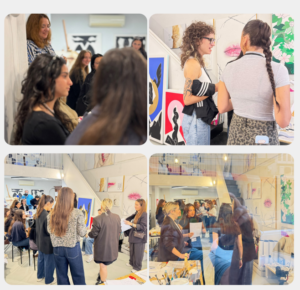
What if an entire city had two and a half hours to decide how much airtime women athletes deserve? That was the question facing the players of The Race, a liveaction role-playing game presented as part of REWIND LARP in Thessaloniki on 10 October, at Studio Christinas Michalopoulou. The Race is a LARP about the underrepresentation of women’s sport in the media. Participants did not sit through a talk on equality. Through their characters, they negotiated it, voted on it and, at times, betrayed it. The game brought together 32 participants and was facilitated by PYLON ONE. An imaginarycity,veryrealdilemmas The game is set in Clearbourg, an imaginary city of one million people in a valley ringed by snow-capped mountains. Every 20 May it hosts the “queen of all races”: a 230 km cycling race through forests, up Mount Gemmon and into a final 4 km sprint through the city. This year the men’s race celebrates its 100th edition. The women’s race is only in its third, won after years of grassroots campaigning. Until 1999, the rules barred women even from working as race staff. The city’s past holds stories that still hurt. In 1956 Helene Varin finished the race disguised as a man, 107th out of 122 riders, and her name was erased from the records. The local winner of 1988 has a plaque on City Hall; the two local winners of the women’s race have never been honoured. SPORTisYOU is preparing a new programme about them. On the same day, citizens elect a new President of the Organising Committee. Sponsors are threatening to pull out, politicians speak of “ideological propaganda” , and the “Truth on Two Wheels” campaign wants the silences broken. WOMEN PROJECT Journalists,sponsors,athletes:everyoneatthesamebargainingtable WOMEN PROJECT Participants were split into six groups: journalists, athletes, managers, fans and citizens, politicians and sponsors. Each group wore its own marker, from the “PRESS” armband to the politicians’ ties. Every player had a character sheet with goals, opinions and secrets. The studio became a city: a Town Hall for petitions and complaints, a Press Room with the programme board, and a Public Square for speeches and the ballot box. At the heart of the game was a simple board with seven slots: one opening story, two athlete profiles, two scandals or investigations, one sponsor spotlight and one live interview. Who would fill those slots was the question that drove everything. To influence it, players had tools that look a lot like real life. Favour Cards for trading favours, Support Cards standing for money and influence, sponsorship contracts, citizens’ petitions with signatures, and Scandal Cards for anyone who caught someone buying airtime. An athlete who wanted to sign a petition for equality first had to give up their sponsorship. When therolescomeoff The session closed with a debriefing, where participants stepped out of their characters and spoke as themselves. They talked about how they felt, who really held the power, and why some stories made it on screen while others were left out. The game unfolded in three acts: lobbying and negotiation, voting and the election of the President, and finally the big press conference, where the journalists presented the programme and faced the audience’s reactions. The game offers no ready-made answers. It does show how easily an athlete’s visibility depends on sponsors, votes and trade-offs, and not only on how fast she sprinted. The discussion was linked to real data on how women are represented in sports media. Clearbourg does not exist. Its dilemmas, though, are there every time we switch on a sports broadcast.